About Phantom of the Paradise
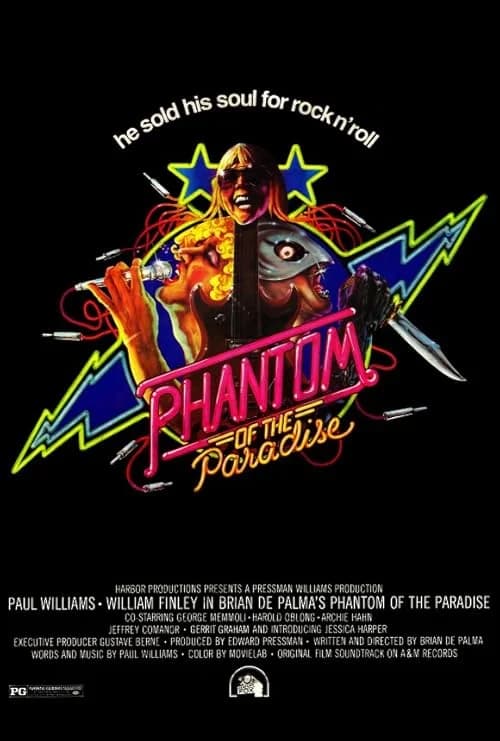
Brian De Palma's 1974 cult classic 'Phantom of the Paradise' is a dazzling, genre-bending spectacle that defies simple categorization. Part rock opera, part horror satire, and part tragic romance, the film follows composer Winslow Leach, whose life's work is stolen by the sinister music mogul Swan. After a horrific accident disfigures him, Winslow becomes the phantom haunting Swan's new rock palace, The Paradise, seeking revenge and protecting the innocent singer Phoenix, whom he loves.
The film is a masterful pastiche, weaving together elements of 'The Phantom of the Opera,' 'Faust,' and 'The Picture of Dorian Gray' into a vibrant 1970s rock context. Paul Williams, who also composed the brilliant and eclectic soundtrack, delivers a chilling performance as the manipulative Swan. William Finley is heartbreakingly tragic as Winslow, and Jessica Harper shines as the pure-voiced Phoenix. De Palma's direction is flamboyant and inventive, filled with his signature split-screens and stylistic flourishes.
Viewers should watch 'Phantom of the Paradise' for its sheer audacity and creative energy. It's a film that has earned its devoted cult status through its unique vision, unforgettable music by Paul Williams, and its sharp satire of the music industry's exploitative nature. More than just a movie, it's a wild, emotional, and visually stunning experience that remains utterly original nearly 50 years later.
The film is a masterful pastiche, weaving together elements of 'The Phantom of the Opera,' 'Faust,' and 'The Picture of Dorian Gray' into a vibrant 1970s rock context. Paul Williams, who also composed the brilliant and eclectic soundtrack, delivers a chilling performance as the manipulative Swan. William Finley is heartbreakingly tragic as Winslow, and Jessica Harper shines as the pure-voiced Phoenix. De Palma's direction is flamboyant and inventive, filled with his signature split-screens and stylistic flourishes.
Viewers should watch 'Phantom of the Paradise' for its sheer audacity and creative energy. It's a film that has earned its devoted cult status through its unique vision, unforgettable music by Paul Williams, and its sharp satire of the music industry's exploitative nature. More than just a movie, it's a wild, emotional, and visually stunning experience that remains utterly original nearly 50 years later.